SEO Version


35
WHYTES
S I N C E 1 7 8 3
,
47
Thomas Snagg (1746-1812)
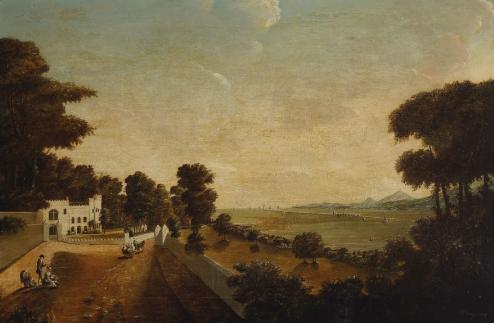
VIEW OF CLONTARF CASTLE, 1805
oil on canvas
signed and dated lower right
24 by 36in. (60.96 by 91.44cm)
Provenance:
Stackallan House Co. Meath Sale, Christie’s, 20 October, 1992, lot 197;
Private collection
This rare Thomas Snagg oil painting places its main feature- Clontarf Castle - on
the left-hand side of the picture, a characteristic also found in the works of his
exact contemporary William Ashford who had dominated Irish landscape painting
for a quarter of a century before Snagg put brush to canvas here in 1805. The
castle stands on the site of the Norman fortress built around 1200 by the Knights
Templar and the tower at the right-hand end of the building may be part of a later
medieval commandery of the Knights Hospitallers to whom the property was
transferred in the 14th century. The remainder of the castle seen in Snagg’s canvas
is probably a creation of the later18th century; one of the earliest examples of the
Neo-Gothic style in Ireland, and the predecessor of the present Tudor-Revival
structure designed by William Vitruvius Morrison in 1836. A closer view of 1772 by
Gabriel Beranger, of which there is a watercolour copy in the National Library,
shows out the Gothic fenestration more clearly. In 1998, Sotheby’s auctioned for
£40,000 a sketch of the castle of around 1817, allegedly by the famous English
painter J.M.W. Turner, which was apparently copied from an original by Maria
Sophie Vernon. She was a member of the family which had been in residence
since the mid-17th century - the builders of the structure painted by Snagg - and
whose name is still attached to the various roads in the vicinity. It is doubtless they
or their guests feature in the charming vignette in the bottom of the picture, seen
on the horse-drawn carriage at the top of the road leading down to the sea.
The right half of the picture gives a break in the foliage to reveal a splendid vista of
Dublin Bay, reaching as far as the two Sugarloaves - Dunleary (afterwards,
Kingstown and later Dún Laoghaire) before its harbour was built. A notable feature
is the South Wall, fnished in 1786, and extending from Ringsend (out of sight)
past the Pidgeon House out to the old Poolbeg Lighthouse which helped guide
shipping up the River to the Custom House, completed only fourteen years before
Snagg’s panorama was created. A most unexpected, and rather fanciful, feature of
the picture is the series of houses and other buildings presented at such a scale as
to be almost Lilliputian, and placed along the shore where there were probably
slobs at the time, a plan to reclaim which was prepared in the year of the painting,
1805.
Snagg, thrice married, was born in London and became a successful actor,
performing with David Garrick at Drury Lane. He took up painting around the mid-
1770s and travelled as far as St. Petersburg, where he painted Empress Catherine
the Great. On his return journey, Robespierre arrested him and his family in
northern France, where he was held captive for more than a year - an ordeal he
recorded in a print in the British Museum.
In 1804, twelve months before he painted Clontarf, Snagg exhibited four
landscapes at Allen’s in Dame Street, one of which may have been the view of
Dublin Bay seen from the University Rowing Club in Ringsend now in the National
Gallery of Ireland, and which - like the Clontarf picture - has the main building on
the left-hand side of the painting.
Dr. Peter Harbison
Honorary Academic Editor, Royal Irish Academy
February, 2012
€
5,000-
€
7,000 (£4,200-£5,880 approx)
Powered by FlippingBook Publisher