SEO Version


WHYTES
S I N C E 1 7 8 3
,
Well-known for his use of allegory as a method by which to reflect on
political issues in Irish society, and evident in images such as
An Allegory
(1924) and
Night’s Candles are Burnt Out
(1929), Seán Keating was equally
well-capable of utilising those skills to focus attention on the greater
significance of the simple things in life.
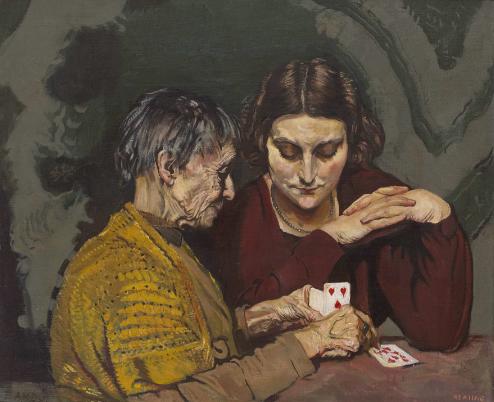
The older woman in
Past Definite, Future Perfect
is reading the cards. She
holds the five of hearts and points to another card from the same suit
lying on the table. Her young companion watches attentively, her hands
clasped to one side so that she can see everything of the procedure.
Both women are focused on the cards, but entirely absorbed in their
own thoughts. At first glance, the picture presents a quiet moment
between, perhaps, a mother and daughter. The only movement is in the
old woman’s gnarled hands and in the swirl of light and dark tones in the
background. Yet the imagery and the artist’s title suggest that this is
more than a simple depiction of a fortune-telling session. The painting
abounds with symbolism: old age presented as the past, beside youth as
representative of the future. The manner in which the old woman
concentrates on the suit of hearts suggests that she is thinking about her
own past loves. The young woman, perhaps unaware that nothing is
perfect, may be hoping for a definite answer about love in the future.
The overarching message is that the gaiety and hope of youth leads
inexorably towards the wisdom and experience of old age.
The theme of old age appears to have been very much on his mind in
1928, a year in which he painted
The Turf Buyer, Old Kitty
and
Good Old
Stuff.
Added to this, his mother Annie (née Hannan), had been suffering
from an unspecified illness for a long number of years; she was nearing
the end of her life in 1928. While this is not a portrait of Annie, it is a
homage painting made in deference to women and to the wisdom of
old age.
The lettering to the bottom left of the image ‘AMDG’ appears to
represent the Jesuit motto ‘for the greater glory of God.’ In other words,
no matter what the cards supposedly say, life will be as it will be.
Past Definite, Future Perfect
was shown in the Royal Academy in London in
1928. A reviewer on the ‘marvellous’ portrait of the old woman
commented on how it had the ‘conviction of a great old age.’ It was
purchased from the exhibition for a private collection at the time and has
not been publically exhibited since.
Dr Éimear O’Connor HRHA,
April 2012
(An extended note is on www.whytes.com)
71
Powered by FlippingBook Publisher