SEO Version


WHYTES
S I N C E 1 7 8 3
,
88
94
Sir John Lavery RA RSA RHA (1856-1941)
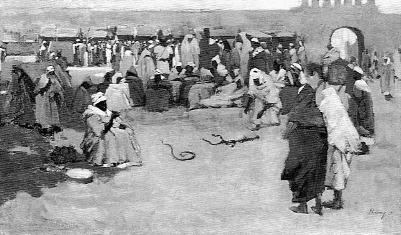
THE SOKO, TANGIER, 1891
oil on canvas
signed and dated lower right
13.75 by 17.25in. (34.93 by 43.82cm)
Provenance:
Sotheby’s, 9 May 2007, lot 70;
Whence purchased by the present owner
Exhibited:
London, Goupil Gallery,
Pictures by John Lavery,
1891, no 4
1
Literature:
Kenneth McConkey,
John Lavery, A Painter and his World,
2010, Atelier
Books, p. 55 (illustrated in colour)
In June 1891 Lavery held his first London solo exhibition of 35 pictures at
the Goupil Gallery in New Bond Street. Of these, at least sixteen were
canvases recently painted in Tangier, the majority of which were scenes of
the busy market place, the Soko. They were examples, according to
The
Athenaeum,
of ‘an extremely clever somewhat feverish and voluptuous
sort of Impressionism which is rich in tone and soft, is pale in tint and
entirely destitute of … surface finish …’
2
The Saturday Review
concurred:
Lavery’s Tangier paintings were ‘coarse in texture and rough in surface …’
and although ‘cleverly painted’, revealed a ‘considerable leaning to the
Impressionist style’.
3
For many critics, Impressionism, the dreaded foreign
import, meant sacrificing fine finish to the exigencies of the moment. An
artist-reporter like Lavery was caught up in the shifting scene and his
picture would lose its vitality if ‘perfected’ in the studio after the event.
The ‘event’, in this case, was of the greatest significance. Although he had
spent his student years in Paris and at the artist’s colony of Grez-sur-Loing,
this was Lavery’s first direct contact with the Muslim world. It came after
the success of pictures such as
The Tennis Party
and his residency at the
Glasgow International Exhibition of 1888. This had resulted in a
commission from the city to paint
The State Visit of Queen Victoria ...
a work
that took two years to complete, and it was only when it received royal
approval that in the first week of January 1891, the painter boarded a
vessel at Tilbury bound for North Africa.
4
Tangier, the ‘White City’, his
destination, came strongly recommended by his Glasgow School friend,
Joseph Crawhall, who had been there in 1888, following in the footsteps
of Denholm Armour, Alexander Mann and other Scots painters.
5
For
Lavery it was a life-changing moment; like his predecessors, he was
immediately captivated. Although he painted in the Kasbah and on the
rooftop of the Continental Hotel, it was the Soko at the eastern gate of
the city that claimed most of his attention. He was not alone. Travellers
commended this ‘big bare area’,
... filled with a motley assemblage of Tangierines, [sic] country people
and visitors, eddying about various centres of interest – the snake
charmer with his dishevelled locks and monotonous drum, the Arab
reciter, or the gentleman who sells you half a pint of copper coins for
sixpence ...
6
Yet others went into detail. Here were,
Crouching camels with their loads of dates, chaffering traders,
chattering women, sly and servile looking Jews from the city, fierce-
eyed heavily armed children of the desert, rough coated horses,
lank-sided mules ... the whole enveloped in a blinding, bewildering,
choking cloud of such dust as only Africa, “
arida nutrix
” can
produce ...
7
The dry, chalky pigment of the present canvas, perfectly expresses the
heat and dust of the Soko. It exposes the untruth of those numerous
counterfeit Salon Orientalists whose colourful Arab genre scenes were
confections of the studio. Here in the market-place, the colours were drab.
Where
Snake Charmers
(see fig. 1) provides a glimpse of wayside theatre,
The Soko
sweeps the crowded space and looks up to the Kasbah, catching
sight of the glistening Straits of Gibraltar beyond.
It was an unforgettable scene to which Lavery would return at regular
intervals up until 1920 when this same space was thronged with
bystanders as Moroccan troops occupied the German Legation.
8
In each
of these many instances, Lavery positioned himself on the south-eastern
side of the Soko, where, as in the present canvas, the shade from nearby
buildings protected him from the sun’s glare. Figures, animals, white
buildings, picked out in bright light and shade against brilliant blue skies,
provided a marquetry of flat shapes that, as Norman Garstin confirmed,
charmed the eye of the sketcher.
9
Lavery may superficially borrow such
effects from the watercolours of Crawhall and Arthur Melville, but he gives
them substance in his oil sketches of the Soko.
10
John Forbes-White who
wrote the introduction to the Goupil exhibition catalogue was particularly
enamoured with these swift studies. He wrote that they were ‘intensely
decorative as well as true … artistic as well as real’
The numerous studies at Tangier show broadly and simply [that]
these truths are felt in the glowing sunshine and cool shade of the
narrow streets … However slight it may be the work charms from its
freshness and sweetness. If it makes a demand on our intelligence
and sympathy, it is a demand, the yielding of which, gives a zest to
our enjoyment.
11
In 1891, in the dusty marketplace, seen for the first time, the ‘impression’
contained all the ‘charm’ and ‘freshness’ of ‘truth’.
1
Three of Lavery’s Tangier pictures in this show, nos 4, 7 and 13 were general
views of the Soko. Of these, no. 4 was simply entitled
The Soko - Tangier,
while the
others were
The Little Soko – Tangier
and
Camels – The Soko
respectively. Of these,
only the present canvas has come to light.
2
The Athenaeum,
13 June 1891, pp. 772-3.
3
The Saturday Review,
20 June 1891, pp. 742-3.
4
Kenneth McConkey,
John Lavery, A Painter and his World,
2010, (Atelier Books), pp.
40-49, 53-4. The
State Visit of Queen Vctoria to the International Exhibition, Glasgow,
1888,
1890 (Glasgow Museums) was exhibited in Maclean’s Gallery in the
Haymarket, London.
5
Kenneth McConkey, ‘Incongruous Impressions: Scottish Painters’ Journeys at the
turn of the Twentieth Century’,
Journal of the Scottish Society for Art History,
vol 14,
2009-10, pp. 78-89.
6
Stanley J Weyman, ‘On Muleback in Morocco’,
English Illustrated Magazine,
1892,
p. 614.
7
HD Traill, ‘The Pillars of Hercules’, in
The Picturesque Mediterranean, Its Cities, Shores
and Islands,
n.d. [c1890], (Cassell and Co), p. 6.
8
McConkey, 2010, p. 147.
9
Norman Garstin, ‘Tangier as a Sketching Ground’,
The Studio,
vol 11, 1897, pp. 177-
182.
10
Melville first traveled to the Middle East, visiting Egypt and Persia in 1882 but did
not visit southern Spain until 1890 and may not have crossed the Straits until a
year later.
11
J F-W, ‘Note’,
Pictures by John Lavery,
1891, (exhibition catalogue, The Goupil
Gallery, London), pp. 7-8
Prof. Kenneth McConkey
April 2012
€
20,000-
€
25,000 (£16,393-£20,491 approx).
Figure 1.
The Snake Charmers, 1891 (private collection)
Powered by FlippingBook Publisher